

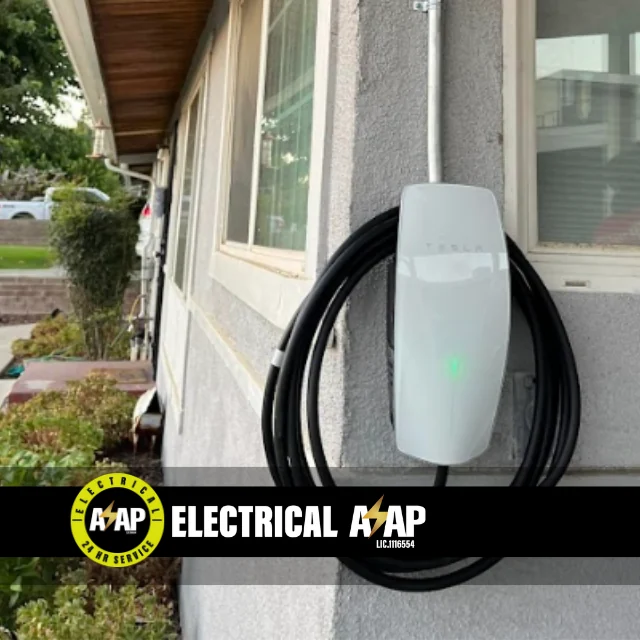
Adding chargers at a business or apartment is an electrical project first. The questions that matter are how much capacity the service and panels have, where the parking is, how the conduit gets there, and who will use the chargers: tenants, employees, customers, or a fleet.
Electrical ASAP is a licensed and insured electrical contractor based at 6801 Weldon Ave in Bakersfield, and a Tesla certified installer. We do the load calculation, plan the layout, pull the permit with the City of Bakersfield or Kern County, and install Level 2 charging. For a home charger see EV charger installation and NEMA 14-50 outlet installation. For suite work see commercial tenant improvements.
Level 2 and DC fast charging, in plain terms
Level 2 charging runs on 240-volt or 208-volt power, the same class of power as a large appliance circuit. It is the usual choice for workplaces, apartments, and fleets that park for a few hours or overnight. People can charge while they work, sleep, or while a vehicle sits on the lot.
DC fast charging is a different class of project. It delivers a much quicker charge, and it asks far more of the electrical service. We install Level 2 systems. If you are considering DC fast charging, we can review the service and tell you what the building would have to support before anyone orders equipment.
Load calculation and panel capacity
Before we talk about how many chargers to put in, we calculate the existing electrical load and what is left on the service and panels. A row of Level 2 chargers can fill a panel or a service that already runs HVAC, lighting, and tenant meters.
If capacity is tight, options can include load management (chargers that share a limited feed), a new panel or subpanel, or a service upgrade. We explain those tradeoffs in writing so you can decide before work starts. When a utility change is part of the job, we coordinate that with the power company.
Tenants, employees, customers, and fleets
The use case changes the layout. Apartment charging often comes down to meter and panel layout, which spaces can be assigned or shared, and how residents get access. Workplace charging is usually about employee or visitor stalls during the day. Retail and customer charging is about a few public stalls and a simple way to start a session. Fleet charging is about overnight parking, how many vehicles return at once, and leaving enough capacity for the rest of the shop or yard.
We walk the property with you, count the stalls that matter, and give you a plan that matches how the site actually operates.
Networked and non-networked chargers
A non-networked Level 2 charger is simpler. It is a good fit when employees or a small group just need to plug in, and you do not need billing or app access.
A networked charger can require a login or card, set hours, collect a fee, or report usage. That is useful for apartments, paid customer stalls, and fleets that want a record of charging. We help you pick the type, then we install the circuits, mounts, and any data path the equipment needs. We do not sell or manage a charging network of our own.
Accessible parking and the path of travel
Charger locations have to work with accessible parking and a clear path of travel. Stall width, reach to the connector, and the route from the parking to the building all get reviewed with the permit. We plan those details up front so the layout can pass review with the City of Bakersfield or Kern County, instead of moving pedestals after the slab is poured.
Permits through the City of Bakersfield or Kern County
The permit office depends on the address. In-city jobs go through the City of Bakersfield. Many sites just outside the city go through Kern County. We pull the permit, meet the inspector, and include that path in the written scope. If the work also needs a utility disconnect or a service change, we plan that timeline into the job.
How we plan a commercial or multifamily install
This is the sequence we use so the project stays predictable for a property manager or business owner:
- Site visit: parking, conduit routes, trench or surface paths, and existing panels
- Load calculation and a clear read on service and panel capacity
- Charger count and layout, including assigned versus shared stalls and accessible parking
- Choice of Level 2 equipment, networked or non-networked
- Written scope, then permits with the City of Bakersfield or Kern County
- Installation, labeling, inspection, and a walk-through for your staff or manager