Quick answer on AC breaker trips
A breaker that trips when the AC kicks on usually points to a worn or failing breaker, a loose or burned connection on the AC circuit, wire that is undersized for the unit, a struggling compressor, or a panel that is near its limit. One trip on a very hot day can happen. Repeated trips, a hot or buzzing breaker, or a burning smell mean you should stop resetting it and call a licensed electrician.
Key facts about AC breaker trips
- Repeated AC breaker trips are a warning sign, not a nuisance.
- Never replace the AC breaker with a bigger one to stop the trips.
- The fix may be a connection, a breaker, the circuit, the panel, or the AC unit itself.
Why the AC is the circuit that gives out first
Your air conditioner is one of the largest loads in your home. When the compressor starts, it pulls a big surge of current for a moment, then settles down. A healthy circuit and breaker handle that surge every time without a problem.
In Bakersfield, the AC can run for most of the day from June through September. Every start and every long run cycle heats the wire, the breaker, and the connections. Any weak spot in that path shows up first in summer, which is why so many breaker calls come in during heat waves.
Common causes of AC breaker trips
A worn breaker is one of the most common. Breakers do not last forever, and one that has handled years of AC starts can begin tripping below its rating. It may also feel warm or have a loose handle.
Loose or burned connections are another. A screw that has loosened at the breaker, the outdoor disconnect, or the condenser creates heat. Heat makes the connection worse over time, and eventually the breaker trips or the wire is damaged.
Undersized wire or the wrong breaker size can be the cause when a larger AC unit replaced an old one without the circuit being checked. The nameplate on the outdoor unit lists the minimum circuit size and maximum breaker size, and the circuit should match.
The AC unit itself can also be the problem. A failing capacitor or a compressor that is struggling to start can draw more current than it should. That is a job for your HVAC company, but we can confirm whether the electrical side is healthy first.
Finally, the panel may be near its limit. If the AC, the dryer, the oven, and a pool pump all run together, an older or crowded panel can struggle. That usually shows up with other signs, like lights dimming across the house.
What you can check on the AC circuit
Note when the trip happens. Does it trip the moment the compressor starts, after it runs for a while, or only on the hottest afternoons? That detail helps whoever comes out.
Look at the panel door without opening the cover. Is the breaker warm to the touch, buzzing, or discolored? Is there a burning smell? If yes, leave it off and call.
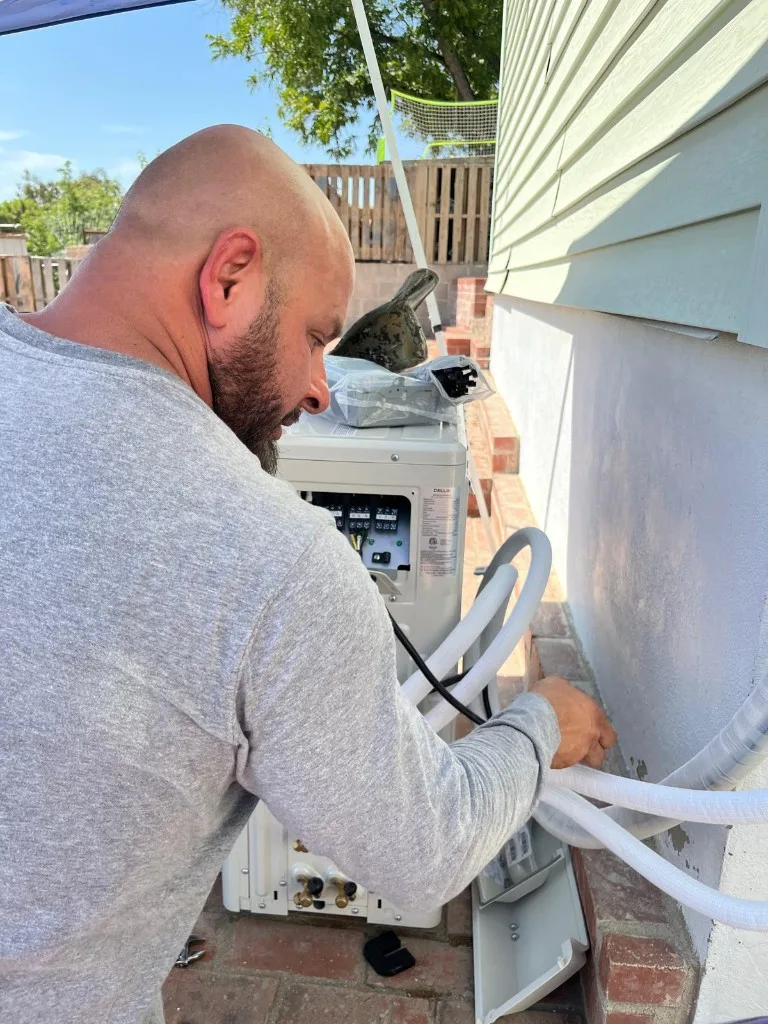
Check the outdoor disconnect box near the condenser for obvious damage, but do not open it or touch wiring. Change the AC filter if it is dirty, since a choked system works harder.
What not to do
Do not keep resetting a breaker that trips over and over. Do not swap in a larger breaker. The breaker size protects the wire, and a bigger breaker lets the wire overheat before anything trips. That turns a nuisance into a fire risk.
Do not tape a breaker on or use an extension cord to run a window unit from another room as a workaround.
When to call about AC breaker trips
Call if the AC breaker trips more than once, if it trips right away when you reset it, or if you notice heat, buzzing, scorch marks, or a burning smell. Electrical ASAP answers 24/7 at (661) 293-0213 and treats heat and burning smell issues as urgent.
We test the breaker, the connections, the wire size, and the load on the panel, then tell you in plain words what we found. If the problem is in the AC unit, we will tell you so you can call your HVAC company. Our page on breakers tripping or lights dimming when the AC runs explains the service in more detail.
Why lights flicker at all when the AC starts
An AC compressor needs a big burst of current for a fraction of a second to get going. That burst causes a tiny drop in voltage across the house. On a healthy system, you may see the lights blink slightly and then settle. Many people never notice it.
Modern LED bulbs can make this more visible than old bulbs did, and some LED dimmers react to small voltage changes. So a light that blinks once when the AC starts is not always a sign of trouble.
Signs that it is more than normal
Watch for dimming that is strong enough to be obvious across the room, dimming that lasts more than a moment, or flickering that keeps going while the AC runs. Those point to a connection or capacity problem.
Another important sign is lights getting brighter in some rooms while they dim in others. That pattern can mean a loose or failing neutral connection. A neutral problem can push higher voltage to some circuits and damage electronics and appliances, so call right away if you see it.
Also call if dimming comes with a warm panel, a buzzing sound, a burning smell, or breakers that trip.
When your neighbor’s AC makes your lights dim
Homes on the same street often share a utility transformer. When a neighbor’s large AC starts, it can cause a small dip for everyone on that transformer. A small, brief dip can happen.
If the dimming is strong, it happens often, or it started recently, the issue may be on the utility side or at your service connection. We can test your side of the meter, including the panel and the main connections. If we find the problem is on the utility side, we will tell you what to report to PG&E.
Common causes we find inside the home
Loose connections at the main breaker, the panel neutral bar, or the AC circuit are common. So is an older panel that is close to its limit after years of added loads like a bigger AC, a pool pump, or an EV charger.
Sometimes the wire or breaker serving the AC is undersized for a newer, larger unit. Other times the cause is a dimmer that is not made for LED bulbs. Testing tells us which one it is, so you only pay to fix the real problem.
How we diagnose it
We start by listening to what you have noticed, then test voltage at a few outlets while the AC starts and runs. We check the main connections, the neutral bar, and the AC circuit, and look for heat or corrosion at the panel and the outdoor disconnect.
If the readings point to the service drop or transformer, we explain what we measured so you can share it with PG&E. If the cause is inside the home, we give you a written quote for the fix before any work starts. Free estimates on planned work and installs, and troubleshooting visits carry a service fee that covers the first hour of labor, including diagnosis.
What to do next
Note which lights dim, how much, and for how long, and whether it happens only when your AC starts or also when the neighbor’s does. Do not open the panel cover.
Call Electrical ASAP at (661) 293-0213. We answer 24/7. Our page on breakers tripping or lights dimming when the AC runs covers how we diagnose this, and if the panel is the bottleneck, we will walk you through options like a dedicated circuit or a panel upgrade.
Bakersfield services for AC breaker trips
Related services for this problem.
Need it done in Bakersfield?
See how we handle it, what it costs, and how fast we can get there: AC breaker tripping and dimming lights. Or call (661) 293-0213, open 24/7.
AC breaker trips FAQs
Is it normal for the AC breaker to trip on a very hot day?
Once, maybe. Repeated trips are not normal and mean something on the circuit, breaker, panel, or AC unit needs attention.
Can I put in a bigger breaker for my AC?
No. The breaker has to match the wire and the unit nameplate. A bigger breaker can let the wire overheat.
Is this an electrician problem or an HVAC problem?
It can be either. We check the electrical side, and if the unit itself is drawing too much, we will tell you so your HVAC company can take a look.
Do you come out after hours?
Yes. We answer 24/7. Call (661) 293-0213 and tell us what you are seeing.
Is it bad if my lights dim when the AC turns on?
A tiny, quick flicker can be normal. Strong or long dimming, or lights getting brighter in some rooms, should be checked.
Can dimming lights damage my appliances?
Ongoing voltage problems, especially from a neutral issue, can damage electronics and motors. That is why we recommend getting it checked.
Will a whole home surge protector fix dimming?
No. Surge protection helps with spikes, but it does not fix a loose connection or an overloaded panel.
Who fixes it, PG&E or an electrician?
Problems on your side of the meter are an electrician job. Problems at the transformer or service drop are PG&E’s. We can test your side and tell you which it is.
Talk to a Bakersfield electrician about AC breaker trips
Call (661) 293-0213 or use the contact form.